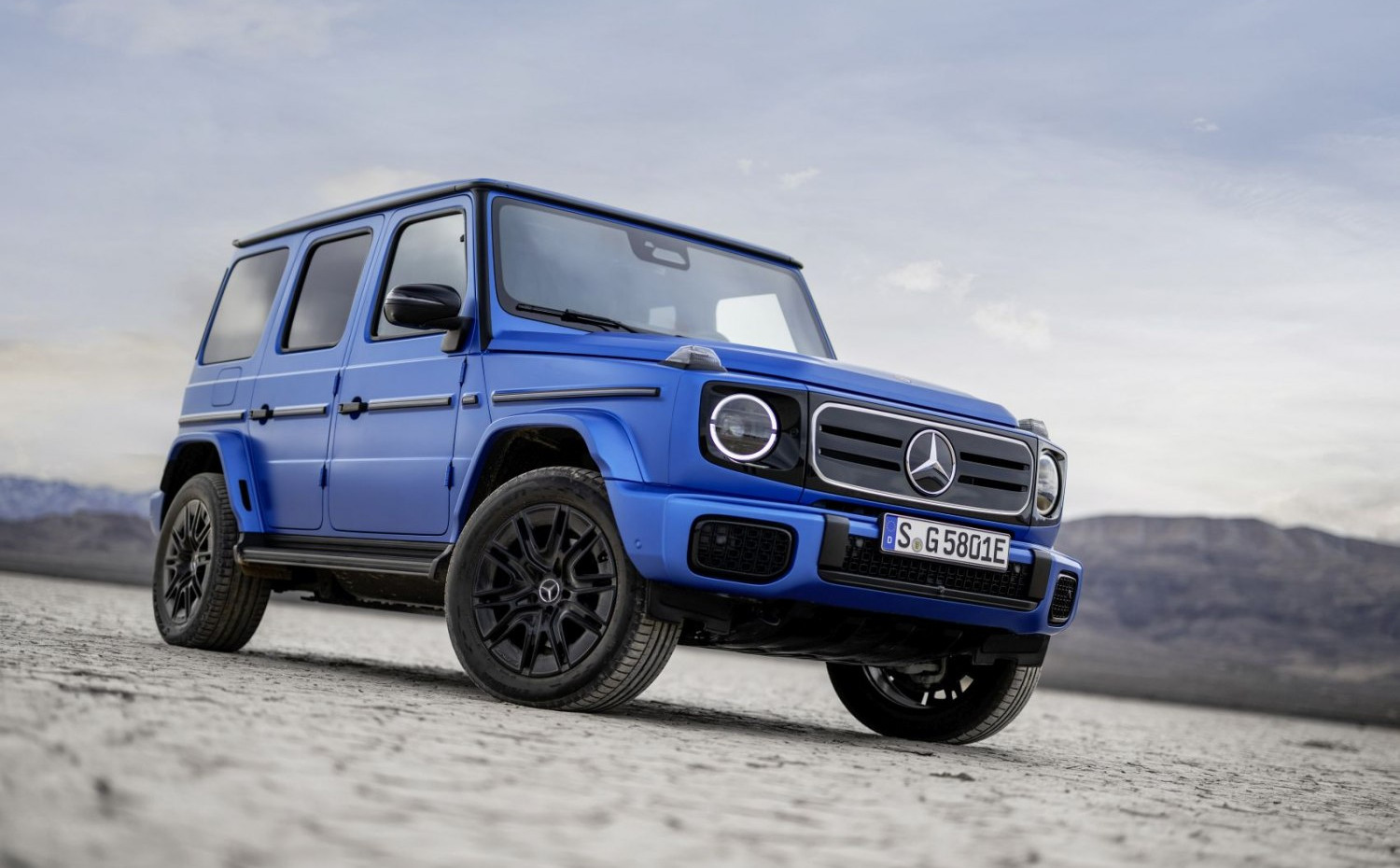
Mercedes-Benz G 550 (443 Hp) Mild Hybrid 4MATIC 9G-TRONIC
⚡ Electric Vehicle
General information
| Electric motor power | 147 Hp |
|---|---|
| Electric motor torque | 291 Nm |
| Brand |
Mercedes-Benz
|
|---|---|
| Model |
G-class
|
| Generation |
G-class Long (W465)
|
| Modification (Engine) |
G 580 EQ 116 kWh (587 Hp) 4MATIC
|
| Start of production |
2024 year
|
| Powertrain Architecture |
BEV (Electric Vehicle)
Powertrain architecture classifies the propulsion technology of the vehicle, such as internal combustion, electric (BEV), or hybrid.
|
| Body type |
Off-road vehicle
Body type refers to the structural design and shape of the vehicle (such as Sedan, Hatchback, SUV, or Coupe).
|
| Seats |
5
Seat count specifies the maximum passenger capacity the vehicle is legally approved to transport at once.
|
| Doors |
5
Door count indicates the total number of entry points for passengers and cargo access (e.g., 3-door, 5-door).
|
FAQ
Performance specs
| Fuel Type |
Electricity
Fuel type defines the primary source of energy required by the vehicle’s engine (petrol, diesel, electricity, hybrid, LPG, etc.).
|
|---|---|
| Acceleration 0 - 100 km/h |
4.7 sec
The 0-100 km/h sprint time measures how quickly the vehicle accelerates from a standstill. It is a key indicator of raw performance and responsiveness.
|
| Acceleration 0 - 62 mph |
4.7 sec
The 0-100 km/h sprint time measures how quickly the vehicle accelerates from a standstill. It is a key indicator of raw performance and responsiveness.
|
| Acceleration 0 - 60 mph |
4.6 sec
|
| Maximum speed |
180 km/h, Electronically limited
Maximum speed represents the upper limit of velocity the vehicle can reach, limited by gear ratios, engine power, and aerodynamic resistance.
|
| Weight-to-power ratio |
5.1 kg/Hp, 195 Hp/tonne
|
| Weight-to-torque ratio |
2.6 kg/Nm, 386.7 Nm/tonne
|
Electric cars and hybrids specs
| Net Usable Battery Capacity |
116 kWh
|
|---|---|
| Battery technology |
Lithium-ion (Li-Ion)
|
| Battery location |
Below the floor
|
| recuperation-output |
217 kW
|
| All-electric range (WLTP) |
434-473 km
All-electric range represents the maximum distance the vehicle can cover on a single full charge using purely electric energy.
|
| Average Energy Consumption (WLTP) |
27.7-30.3 kWh/100 km
|
| Electric motor power |
147 Hp
|
| Electric motor torque |
291 Nm
Torque represents the engine’s rotational force, which determines pulling power. High torque ensures responsive acceleration and stronger uphill performance.
|
| Electric motor location |
Front axle, Transverse
|
| Electric motor type |
Synchronous
|
| Electric motor power |
147 Hp
|
| Electric motor torque |
291 Nm
Torque represents the engine’s rotational force, which determines pulling power. High torque ensures responsive acceleration and stronger uphill performance.
|
| Electric motor location |
Rear axle, Transverse
|
| Electric motor type |
Synchronous
|
| System power |
587 Hp
|
| System torque |
1164 Nm
Torque represents the engine’s rotational force, which determines pulling power. High torque ensures responsive acceleration and stronger uphill performance.
|
Space, Volume and weights
| Kerb Weight |
3010 kg
Curb weight is a key parameter affecting fuel consumption, handling agility, acceleration times, and stopping distances.
|
|---|---|
| Max. weight |
3500 kg
Curb weight is a key parameter affecting fuel consumption, handling agility, acceleration times, and stopping distances.
|
| Max. load |
490 kg
|
| Trunk (boot) space - minimum |
555 l
|
| Trunk (boot) space - maximum |
1990 l
|
Dimensions
| Length |
4624 mm
|
|---|---|
| Width |
1931 mm
|
| Height |
1986 mm
|
| Wheelbase |
2890 mm
|
| Front track |
1638 mm
|
| Rear / Back Track |
1637 mm
|
| Front overhang |
885 mm
|
| Rear overhang |
849 mm
|
| Ride height (ground clearance) |
250 mm
|
| Drag coefficient (Cd) |
0.44
|
| Minimum turning circle (turning diameter) |
13.6 m
|
| Approach angle |
32°
|
| Departure angle |
30.7°
|
| Ramp/Breakover angle |
20.3°
|
| climb-angle |
45°
|
| Wading depth |
850 mm
|
Drivetrain, brakes and suspension specs
| Drivetrain Architecture |
Four electric motors drive each wheel individually.
Drivetrain type specifies which wheels receive power from the engine. This affects road grip, cornering, and stability on slippery surfaces.
|
|---|---|
| Drive wheel |
All wheel drive (4x4)
Drivetrain type specifies which wheels receive power from the engine. This affects road grip, cornering, and stability on slippery surfaces.
|
| Number of gears and type of gearbox |
2 gears, automatic transmission
|
| Front suspension |
Double wishbone, Independent coil spring
The suspension system absorbs road bumps, providing cabin comfort and keeping tires firmly planted on the road surface.
|
| Rear suspension |
Suspension De-Dion, Coil spring
The suspension system absorbs road bumps, providing cabin comfort and keeping tires firmly planted on the road surface.
|
| Assisting systems |
ABS (Anti-lock braking system)
|
| Steering type |
Steering rack and pinion
|
| Power steering |
Electric Steering
|
| Tires size |
265/60 R18; 275/50 R20
Tire size specifies the tread width, aspect ratio, and rim diameter, affecting the balance between handling grip and ride comfort.
|
| Wheel rims size |
7.5J x 18; 20
|
Common OBD2 Fault Codes
Similar Models

User Reviews
J
James 90
16 months ago
★★★★★
Been driving it for 3 months now. N/A efficiency is surprisingly good for this class. The exterior design looks sharp and modern in person. Electric torque is addictive, so quiet. Planning to keep it for a long time.
•
O
Oliver 77
7 weeks ago
★★★★★
Anyone knows the real-world N/A usage?
•
G
George B.
12 months ago
★★★★☆
Mainly using it for my daily commute to work. N/A efficiency is surprisingly good for this class. The handling in corners is very safe. Charging at home is super cheap, maintenance is minimal. Value for money is unmatched, highly recommended.
•
W
William 92
26 months ago
★★★★★
How is the long-term reliability of this model?
•
G
George S.
3 months ago
★★★★★
Ordered it immediately after a quick test drive. N/A efficiency is surprisingly good for this class. Sound insulation is great, very quiet cabin at high speeds. Instant torque and linear acceleration are amazing. I highly recommend it, won't disappoint.
•
T
Thomas 92
17 days ago
★★★★★
Got this car a few months ago. The N/A hp feels powerful on the road. Suspension handles bumps and rough roads very smoothly. Charging at home is super cheap, maintenance is minimal. Worth every single penny spent.
•
N
Noah V.
15 weeks ago
★★★★★
Perfect size and choice for our small family. N/A economy is better than I expected. Comfort is top-notch, great seats. Electric torque is addictive, so quiet. If you're undecided, just go for it.
•